

Chloe McElhone is Clean Prosperity’s Research Manager.
As the federal and provincial governments carve a path forward on industrial carbon pricing, a parallel carbon market — operating under a policy called the Clean Fuel Regulations (CFR) — is gaining importance for low-carbon investment decisions, particularly for carbon capture projects.
The July 2026 trilateral Memorandum of Understanding (MOU) between Canada, Alberta, and the Oil Sands Alliance has raised the stakes for the CFR. Policymakers have committed to making the CFR a more predictable, bankable tool for upstream oil decarbonization.
In the coming months, Clean Prosperity will further investigate how the CFR interacts with other climate policies and ongoing trade tensions with the U.S. — bringing forward detailed analysis and recommendations to help policymakers build a predictable, investment-ready framework.
What are the Clean Fuel Regulations?
The Clean Fuel Regulations (CFR) drive down the carbon emissions of transportation fuels used in Canada. The CFR obligates primary suppliers — companies that produce or import large volumes of gasoline and diesel — to gradually reduce the carbon intensity of their fuels. Specifically, the CFR requires suppliers to cut their fuels’ carbon intensity (measured in emissions released per unit of energy) by about 15% below 2016 levels by 2030.
Regulated fuel suppliers can meet these annual targets by creating or buying credits, where each credit equals one tonne of CO2e reduced. Crucially, the system allows third parties, such as electric vehicle charging networks, to generate and sell credits. By selling these credits to obligated fuel suppliers, low-carbon investors can generate an ongoing revenue stream.
There are three ways to produce CFR credits:
- Reducing the carbon intensity of liquid fossil fuels (Compliance Category 1), such as carbon capture and storage for oil production, or hydrogen fuel as feedstock for refining.
- Supplying low-carbon fuels (Compliance Category 2), such as blue or green hydrogen, renewable natural gas, ethanol, or biodiesel.
- Enabling consumer fuel-switching (Compliance Category 3), such as building electric vehicle charging stations.
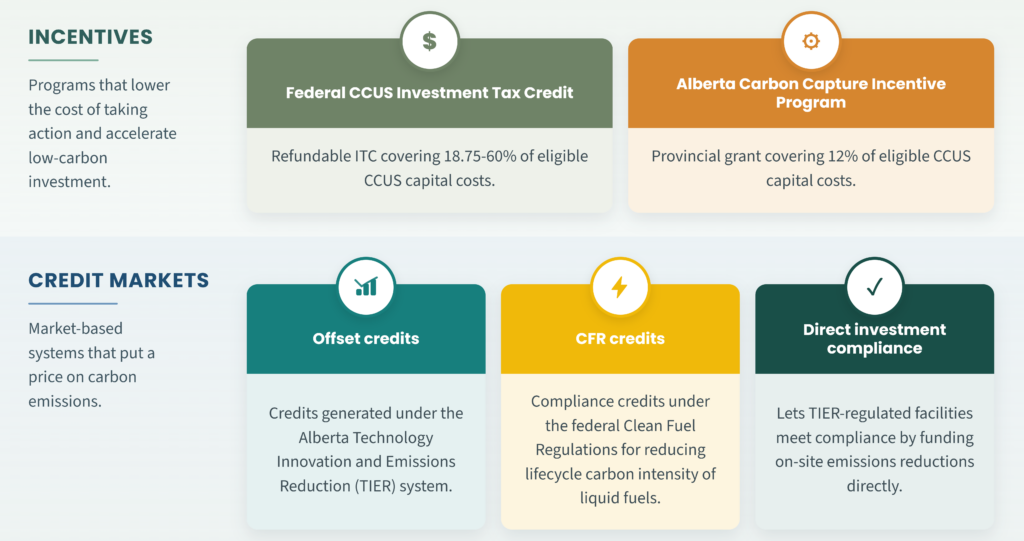
Good climate policy gives investors two things: a clear price signal and confidence that it will hold. In Canada, carbon capture, utilization, and storage projects can access a variety of policy-based financial incentives to achieve economic viability, including tax credits and industrial carbon markets.
Policy-based financial incentives for low-carbon investments in Alberta
The challenge: export rules made credit revenue unpredictable
Canadian upgraders that process crude oil or bitumen can earn credits by reducing the carbon intensity of fuels through projects such as carbon capture and permanent storage, enhanced oil recovery with carbon capture and permanent storage, and low-carbon-intensity electricity integration.
But there’s a catch. Because the CFR is a regulation on Canadian fuels, credits can only be claimed for the share of crude oil or bitumen used in Canada.
Because Canada exports approximately 80% of its crude oil, this rule severely dilutes the incentive for upstream producers. For example, if an upgrader captures 1 million tonnes of CO2e per year, but 70% of its oil production is exported to foreign refineries, the facility is eligible to receive CFR credits for the remaining 30% refined domestically, yielding 300,000 credits. However, if a company does not have records of its export volumes, the CFR uses a default value assumption that 20% of production stays in Canada, in line with historical domestic retention averages.
For companies weighing expensive, decade-spanning carbon capture investments, this created unacceptable revenue volatility. Over a 20-year project timeline, a producer cannot control where its crude ultimately gets refined. Market demand, pipeline routes, and export destinations constantly shift. Combined with data track gaps across complex supply chains, these changes meant a project’s CFR credit yield could change unexpectedly, making future revenue difficult to predict.
What the MOU changes
The trilateral MOU signed between the federal government, Alberta, and the Oil Sands Alliance directly addresses this bankability hurdle. Under the agreement, the federal government has committed to maintain at least a 20% credit creation rate for low-carbon projects in upstream oil production under the CFR — even if the vast majority of output is exported.
This regulatory guarantee establishes a reliable policy floor for carbon capture and storage projects in upstream oil production. Project revenue will no longer depend on the downstream refining destination, a variable that is largely outside the producer’s control and prone to shifts over multi-decade project lifespans. And while producers can still earn credits over 20% if they can prove that a higher proportion of their crude was refined domestically, they now have a guaranteed baseline credit yield that they can write into their capital plans and present to lenders.
What comes next
The CFR credit market already offers a strong price signal, with credits reaching $367 per tonne in late 2025 (and exceeding that in 2026). The trilateral MOU provides the certainty investors need to count on those credit revenues when committing to major low-carbon projects.
For proponents weighing multi-billion-dollar carbon capture and storage projects, no single policy determines a project’s fate. What matters is how these federal and provincial incentives stack together, from capital tax credits and carbon pricing schedules to broader amendments to the CFR. Getting that total economic picture right is critical if projects are to move from proposed ideas to final investment decisions.
Photo credit: NRCan