
The Ontario government should significantly increase its climate ambition in order to keep up with the priorities of Ontario voters. That’s the message of a new Clean Prosperity/Leger poll of 10 significant Ontario provincial electoral districts.
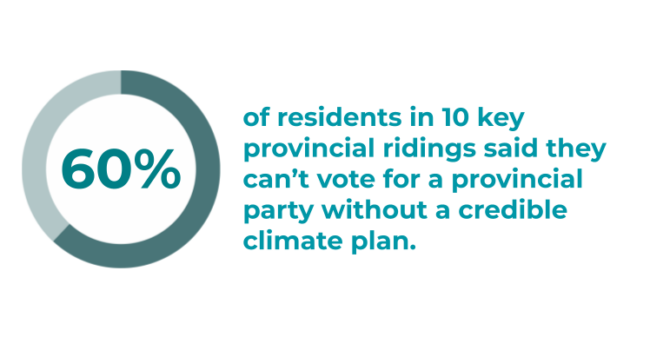
Ontarians expect their provincial government to have a credible climate plan. A full 60% of poll respondents said they can’t vote for a provincial party that doesn’t have a credible plan.
About three-quarters of voters in these ridings are worried about the impact that climate change could have on their families. By a margin of nine one, respondents said the provincial government should do more to address climate change.
Unfortunately, Ontario’s current climate policy is out of step with Canada’s goal of achieving net-zero emissions by 2050, a target that’s supported by about three quarters of voters. Ontario needs an ambitious climate policy not only to achieve net-zero, but also to take advantage of the economic opportunities that come with decarbonization.
“Decarbonizing the Ontario economy will be a big challenge, but it also promises to deliver huge economic benefits.”
Clean Prosperity Executive Director Michael Bernstein
In addition to the poll data, Clean Prosperity has developed a set of recommendations that show how boosting Ontario’s climate action can help create good-paying jobs, reduce long-term costs for consumers and businesses, and position the province to remain competitive in the global low-carbon economy of the future.
“Decarbonizing the Ontario economy will be a big challenge, but it also promises to deliver huge economic benefits,” said Clean Prosperity Executive Director Michael Bernstein. “What’s more, a large majority of Ontarians expect their provincial government to get on board with Canada’s national net-zero commitment, and that means more ambitious climate action — now.”
Leger conducted a poll of 1,511 respondents in 10 key Ontario provincial electoral districts, drawn from its online research panel, from 4 to 19 January 2022. Technically, a margin of error should not be associated with a non-probability sample in a panel survey. For comparison purposes, a probability sample of this size would have a margin of error ±2.53%, 19 times out of 20.
Respondents came from the following provincial electoral districts: Ajax, Brampton South, Mississauga East–Cooksville, Mississauga–Streetsville, Eglinton–Lawrence, Etobicoke Centre, Etobicoke North, Etobicoke Lakeshore, Northumberland–Peterborough South, and Willowdale.
Key findings from the poll
- 60% of poll respondents said they can’t vote for a provincial party that doesn’t have a credible plan.
- 74% of voters are worried about the impact that climate change could have on their families.
- By a margin of nine to one, a large majority of voters think the Ontario government should do more to address climate change.
- About three-quarters voters also support the goal of net-zero emissions by 2050.
Documents


